

In distribution and manufacturing, quoting sits at the center of daily commercial activity. Sales teams respond to RFQs (Request for Quotation), project bids, and pricing requests continuously, often across thousands of SKUs, multiple suppliers, and fluctuating lead times. Each request requires accurate cost data, availability checks, margin validation, and compliance with customer-specific pricing rules, all under tight deadlines.
Customers expect quick, precise responses, yet many distributors and manufacturers still rely on manual workflows, email-based RFQ’s, spreadsheets, and tribal knowledge to assemble quotes. These processes are further strained by supply chain volatility, price inflation, supplier delays, and shrinking sales headcount. What once passed as acceptable turnaround times now feels increasingly out of step with modern buyer expectations.
Speed to Quote has emerged as a defining competitive advantage. It directly impacts win rates, customer confidence, and the sales team’s ability to keep pace with high volume and time-sensitive demand. This guide explores why quoting speed matters so much in today's distribution and manufacturing environment, what prevents teams from responding faster, and how AI-powered RFQ automation plays a central role in improving Speed to Quote in a practical, sustainable way.
The reality of RFQs in today’s supply chain
For most distributors and manufacturers, RFQs are the core of the sales workload. Requests arrive constantly, often in different formats and with varying levels of detail. PDFs, spreadsheets, forwarded emails, images and portal downloads all land in the same inbox, creating a steady stream of work that must be interpreted, normalized, and validated before quoting can even begin.
Sales Reps and Account Managers spend a significant portion of their day reviewing these requests, extracting line items, matching part numbers, checking availability, validating costs, and building quotes manually. As RFQ volume increases, this work competes directly with customer conversations, project coordination, and account development. The more time spent assembling quotes, the less time remains for proactive selling and relationship management.
Sales managers face a different challenge. Quote turnaround times vary widely across the team, shaped by experience, workload, and the complexity of each request. Without clear visibility into where time is spent, it becomes difficult to set expectations, identify bottlenecks, or scale best practices. As a result, managers often respond to customer escalations instead of addressing the underlying causes of delay.
At the leadership level, the impact appears as missed opportunities and an inconsistent customer buying experience. Slower quoted responses reduce competitiveness, particularly when buyers are sourcing the same RFQ from multiple suppliers at once. Over time, this creates revenue pressure that feels difficult to pinpoint, even though the root cause sits squarely within the quoting process itself.
Why manual RFQ handling slows down quoting
Manual RFQ handling introduces delays long before a quote reaches a customer. Delays often begin at intake, where every request must be read, interpreted, and translated into usable information. In distribution and manufacturing environments, RFQs rarely arrive in a consistent format. Bid documents, spreadsheets, forwarded emails, and portal exports all require different handling, forcing sales teams to spend time simply figuring out what the buyer is asking for.
Once the request is understood, the most time-consuming work begins. Line items must be re-entered into internal systems, part numbers checked against catalogs, and availability verified across suppliers and warehouses. This process typically involves jumping between email, ERP screens, pricing files, and quote templates. Each handoff breaks momentum. Even experienced reps lose time as they move back and forth between systems that were never designed to work together.
Product complexity adds another layer of slowdown. Catalogs change frequently, substitutes vary by customer or application, and pricing rules are rarely straightforward. Margin targets, contract pricing, and supplier-specific costs all need to be validated. To avoid errors, reps slow down intentionally, double-checking details that should be easy to access. Accuracy and speed become a trade-off, even though customers expect both.
Over time, these manual steps create patterns that teams accept as unavoidable. RFQs begin to stack up during peak periods, and slower turnaround becomes normalized. What appears to be a workload or staffing problem is usually a process issue rooted in how RFQs are handled before a quote ever takes shape. Until that front-end work changes, improvements to quoting speed remain limited, no matter how hard teams push.
What RFQ automation actually means
RFQ automation refers to the process of turning incoming RFQs into structured, usable data without relying on manual interpretation at every step. In practical terms, this means reducing the time spent reading documents, retyping line items, and validating basic request details before a quote can even begin.
It’s important to distinguish RFQ automation from broader sales or order automation. RFQ automation focuses specifically on the earliest stage of the quoting process, the point where requests arrive in inconsistent formats and must be understood, organized, and prepared for pricing. This stage is often overlooked, yet it has the greatest influence on how quickly a team can respond.
RFQ automation does not replace sales judgment or account knowledge. Instead, it removes repetitive preparation tasks that add value, such as copying line items, matching product descriptions manually, or formatting documents. Sales Reps and Account Managers remain responsible for pricing strategy, customer context, and final review, but they begin with a far more complete and reliable foundation.
For distributors and manufacturers aiming to improve Speed to Quote, RFQ automation delivers results faster than changes to CRM or ERP systems. Rather than redesigning downstream workflows, it addresses the bottleneck where most delays originate: the moment an RFQ enters the organization.
How RFQ automation drives Speed to Quote
Speed to Quote improves most dramatically when delays are removed at the start of the quoting process. RFQ automation accelerates this first step, allowing sales teams to move from request to response while customer intent is still high.
Instead of spending time deciphering documents, teams receive RFQs in a structured format that is ready for quoting. This fundamentally changes how work flows through the team and reduces the stop-and-start pattern that defines manual processes. RFQ automation improves Speed to Quote in several crucial ways:
- Faster RFQ intake: requests are processed immediately, regardless of format, reducing the delay between receipt and action.
- Earlier access to usable data: line items, quantities, and descriptions are available upfront, allowing quoting to begin without manual preparation.
- Reduced interpretation effort: less time is spent clarifying, rechecking, or correcting RFQ details before quoting starts.
- More consistent response times: quotes move through a predictable path instead of depending on individual workflows or experience levels.
Quotes move through a predictable path instead of depending on individual workflows or experience levels. As these improvements compound, quoting becomes more responsive without increasing pressure on the sales team. Speed to Quote shifts from being dependent on individual effort to becoming a capability the organization can rely on, even during periods of high RFQ volume.
What high-performing teams get right about RFQ automation
Teams that consistently quote faster tend to treat RFQ handling as a defined process rather than an informal task. Incoming requests follow a clear path, ownership is well understood, and response-time expectations are set across the organization. This structure reduces uncertainty and prevents RFQs from stalling in inboxes or being handled inconsistently.
High-performing teams also apply automation selectively. Instead of automating everything at once, they focus on the steps that consume the most time and offer the least value when handled manually. RFQ intake and preparation typically sit at the top of that list, since improvements at this stage accelerate every step that follows.
Most importantly, high-performing teams measure quoting speed and use it as a signal for improvement. When Speed to Quote is visible, it becomes easier to identify bottlenecks, support Sales Reps and Account Managers, and maintain a consistent customer experience even as RFQ volume grows.
Signs RFQ automation is becoming a necessity
For many distributors and manufacturers, the need for RFQ automation becomes apparent long before it is formally recognized. The symptoms appear gradually, often disguised as workload issues or temporary spikes in demand. One of the earliest signs is RFQs accumulating faster than they can be processed. During busy periods, requests remain unanswered longer than expected, and sales teams begin prioritizing which quotes to handle first rather than responding to all of them promptly. Over time, this creates uneven response patterns that customers notice.
Behavioral signals also emerge. Reps may avoid complex RFQs because they require too much manual effort, or they delay starting them until simpler requests are cleared. This hesitation often reflects process friction rather than a lack of motivation. Customer behavior provides additional signals. Follow-up emails asking for updates become more frequent, and buyers start referencing faster responses from competitors. Even strong relationships feel strain when responsiveness declines.
Internally, managers struggle to pinpoint where delays occur. Quote turnaround varies widely across the team, yet there is no clear data explaining why. When Speed to Quote depends entirely on individual effort instead of a shared process, sustained growth becomes difficult. Recognizing these patterns early allows organizations to address RFQ handling before slower quoting begins to impact revenue and customer loyalty more visibly.
How to start improving Speed to Quote
Improving Speed to Quote does not require a full system overhaul. Most teams see meaningful progress when they focus on a few targeted changes that reduce friction at the start of the quoting process.
The first step is gaining clarity. Mapping the current RFQ to the quote workflow often reveals where time is lost before pricing even begins. RFQs may sit in inboxes waiting for review, pass through multiple hands, or require manual preparation before they are usable. Simply making these steps visible helps teams understand why response times vary. Consistency follows. When RFQs follow a defined path, teams know what happens after a request arrives and what is expected of them. Clear ownership prevents RFQs from stalling, and shared response time expectations create alignment across the team.
From there, distributors and manufacturers can focus on removing manual work where it adds the least value. RFQ intake and preparation are often the most time-consuming steps, yet they contribute little to the quality of the final quote when handled manually. Introducing RFQ automation at this stage shortens the path from request to response without changing how reps price or manage customer relationships.
Finally, Speed to Quote improves when it is measured consistently. Tracking how long RFQs take to turn into customer-ready quotes helps managers identify bottlenecks early and support the team before delays affect customers. Over time, this visibility turns quoting speed into a controllable part of the sales operation rather than a constant source of pressure.
From Speed to Quote to RFQ automation at scale
Speed to Quote is not a one-time improvement. As RFQ volume increases and customer expectations continue to rise, the ability to respond quickly must scale with the organization. This is where RFQ automation moves from a tactical improvement to a foundational capability.
Manual RFQ handling limits how far quoting speed can improve. Even highly disciplined teams eventually hit a ceiling when request volume increases or complexity rises. RFQ automation removes that ceiling by ensuring that incoming requests are handled consistently, regardless of format or volume. Instead of relying on individual effort, distributors and manufacturers gain a repeatable process that supports fast, reliable quoting across the entire sales team.
At scale, RFQ automation creates stability. Speed to Quote becomes predictable rather than variable, allowing teams to grow without sacrificing responsiveness. This shift makes it easier to onboard new sales reps, absorb peak RFQ periods, and maintain a uniform buying experience across regions, accounts, and customer segments.
From faster quotes to a stronger competitive position
Speed to Quote has become a defining factor in how distributors and manufacturers compete, serve customers, and grow revenue. What once felt like a minor operational detail now shapes win rates, customer confidence, and the day-to-day effectiveness of sales teams. Faster quoting is no longer just about working harder; it depends on removing the structural delays that slow responses before pricing even begins.
RFQ automation plays a central role in this shift. During the earliest stage of the quoting process, teams create the conditions for consistent, reliable Speed to Quote across the organization. Sales reps and Account Managers gain time back, managers gain visibility, and customers receive the responsiveness they expect.
As distribution and manufacturer environments continue to move faster, the ability to respond quickly and accurately will only grow in importance. Speed to Quote is not a temporary advantage; it is becoming a baseline expectation. Organizations that treat RFQ automation as a strategic capability are better positioned to meet that expectation today and sustain it as the business scales.
Speed to Quote: how SETVI AI supports RFQ Automation
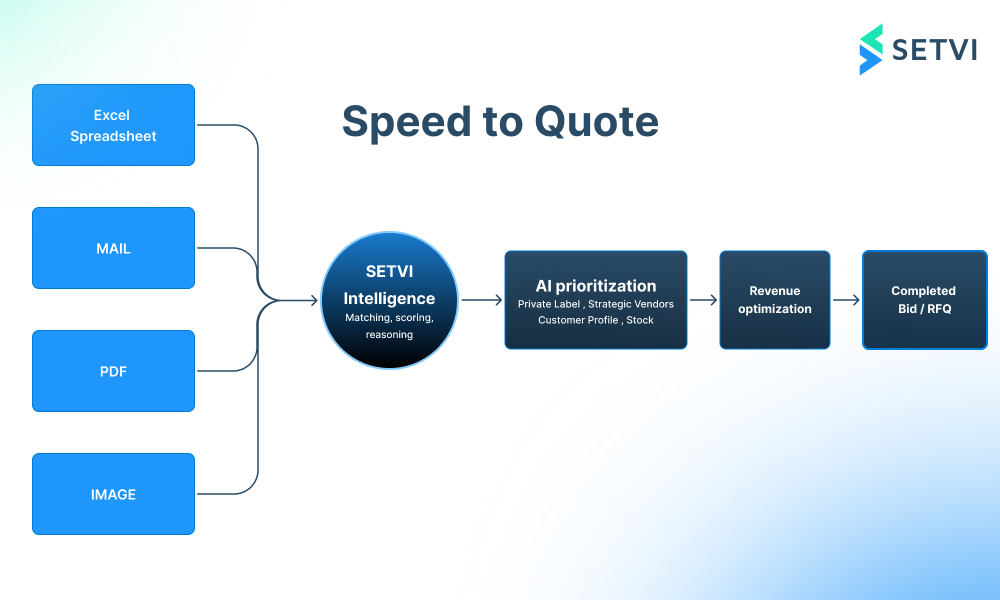
SETVI Auto RFQ addresses this stage directly, converting incoming RFQs into a format that sales teams can work with immediately. It utilizes AI to extract and structure RFQ data, without altering how reps price or sell. For organizations looking to improve Speed to Quote, the biggest gains usually come from automating RFQ intake. This is where requests arrive in unstructured formats and require the most manual effort before quoting can even begin. SETVI Auto RFQ addresses this stage directly, turning incoming RFQs into something sales teams can work with immediately, without changing how reps price or sell.
Uploading RFQs and bid documents
RFQs arrive in many forms, often with little consistency. Auto RFQ is designed to handle this variety without requiring reps to reformat documents or extract information manually. Common input formats include:
- PDF RFQs sent via email
- Excel or spreadsheet-based bid files
- Forwarded emails with embedded product lists
- Images, including photos and screenshots in all formats
Once uploaded, the RFQ moves forward without being delayed by manual review, removing the initial delay that often slows quoting before it starts.
Matching, AI scoring, and reasoning
After intake, SETVI Auto RFQ focuses on understanding what the customer is asking for. AI helps identify line items and match them to your catalog, including product descriptions, quantities, and relevant attributes. Line items are automatically identified and matched, including product descriptions, quantities, and relevant attributes. This step supports sales teams in several ways:
- Items are aligned with known products instead of requiring manual lookup
- Substitutes and alternatives are surfaced where appropriate
- Structured logic supports confidence in how matches are made
Rather than guessing or double-checking every line, reps start with a clearer, more complete view of the RFQ.
AI Prioritization
AI prioritization helps sales teams focus on the most relevant items within an RFQ based on business context and availability, without removing human oversight. Instead of reviewing every line item equally, teams receive guidance on where attention should be applied first. At this stage, teams can:
- Prioritize private label products that align with margin or strategic goals
- Highlight items from strategic vendors based on sourcing preferences
- Factor in the customer profile, such as contract terms or buying history
- Surface items affected by stock levels or availability constraints
This ensures that quotes are built around the most relevant products first, keeping responses fast while aligning with commercial priorities.
Revenue optimization
Revenue optimization focuses on helping teams protect margins and improve quote quality while maintaining speed. Rather than slowing down to review every pricing detail manually, teams receive targeted signals on where pricing decisions may matter most. At this stage, teams can:
- Review flagged items for pricing adjustments or margin sensitivity
- Evaluate suggested alternatives that improve availability or profitability
- Apply customer-specific pricing logic without reworking the entire quote
With clearer guidance on where revenue decisions are needed, teams spend less time searching for risks and more time finalizing competitive, accurate quotes that support both speed and profitability.
RFQ refinement and quote completion
Automation does not remove human oversight. Teams remain fully in control of the quote, reviewing and refining the output before it reaches the customer. At this stage, teams can:
- Adjust product selections or pricing
- Refine quantities or substitutions
- Apply customer-specific context
- Return a customer-ready quote via PDF, spreadsheet or any other channel
Because the groundwork is already complete, these actions take minutes instead of hours, allowing quotes to move forward without unnecessary rework.
Where SETVI Auto RFQ saves the most time
The impact of RFQ automation becomes clear when looking at where time is no longer spent. SETVI Auto RFQ reduces delays across the quoting workflow by eliminating tasks that previously consumed a large share of the day. Key time savings come from:
- Removing manual data entry at RFQ intake
- Reducing time spent searching catalogs
- Limiting back-and-forth clarification before quoting
- Creating a more predictable path from RFQ to response
As a result, Speed to Quote improves consistently across the team, not just for the fastest individual reps. If you want to find out how distribution teams overcome quoting bottlenecks and achieve Speed to Quote with SETVI, talk to our experts.
For a deeper look at how automated RFQ handling eliminates manual work and accelerates quoting, this topic is explored further in the companion article: SETVI Auto RFQ: Eliminating Manual RFQ Processing for Distributors & Manufacturers.
FAQs
What does “Speed to Quote” mean in a distribution & manufacturing context?
Speed to Quote refers to the time it takes to move from receiving an RFQ or bid to delivering a complete, customer-ready quote. In distribution and manufacturing, this speed directly affects win rates because buyers often compare multiple suppliers simultaneously.
Why is RFQ automation more impactful than improving downstream sales tools?
RFQ automation targets the earliest stage of the quoting process, where most delays originate. Improving speed at intake accelerates every step that follows, while downstream tools cannot compensate for slow or manual RFQ handling.
Does RFQ automation remove control from Sales Reps or Account Managers?
No, RFQ automation removes repetitive preparation work while leaving pricing decisions and customer context firmly in human hands. Reps remain responsible for review and final approval, but they start from a structured and reliable base.
How does AI support Speed to Quote at SETVI?
SETVI uses AI to interpret incoming RFQs, extract line items, and match requests to the right products faster than manual processing allows. This reduces preparation time at the start of the quoting process, so sales teams can respond more quickly while remaining fully in control of pricing and final decisions.
How can organizations tell if slow quoting is costing them business?
Frequent customer follow-ups, inconsistent quote turnaround across reps, and RFQs piling up during busy periods are common warning signs. These patterns often indicate process bottlenecks rather than workload or staffing issues.
Is RFQ automation only useful for large teams?
Smaller teams often benefit just as much, because manual RFQ work consumes a larger share of their available time. Even modest improvements in Speed to Quote can significantly improve responsiveness and customer experience without adding headcount.
About the Author
Bobby Kutowaroo is a revenue focussed business development leader with over 20+ years of experience supporting distributors and manufacturers to consistently generate pipeline and close new and existing business, leveraging his time at Epicor Software and OpenText and hands-on experience alongside enterprise partners including Salesforce, SAP and Oracle.
.png)







.webp)