
Revenue enablement is becoming essential for distributors and manufacturers who are trying to keep up with customer expectations. Reps are under pressure to answer quickly, prepare accurate quotes, and support accounts that expect immediate attention. Yet most teams still work through manual tasks that slow everything down.
This shift has created a growing need to clarify what revenue enablement really means for sales teams in these industries. For a deeper look at how revenue enablement differs from traditional sales enablement and why that matters for growing businesses, see this article on Revenue Enablement vs Sales Enablement.
Instead of spending their day selling, reps often face time-consuming steps such as copying item details from customer emails, checking multiple systems, and formatting every quote from scratch. Tools like Auto RFQ remove this burden and give sales teams a clearer path to serving customers without delays, using AI to interpret RFQs and prepare them for faster quoting.
The hidden cost of slow, manual quoting
Slow quoting rarely shows up as a formal metric, but its impact is felt across every sales team. Customers don’t wait long, especially when they’re comparing several suppliers at once. If a quote takes too long to prepare, the opportunity weakens, even if pricing and product fit are strong.
What slows quoting down today?
- Reps manually reading and transcribing information from PDFs, spreadsheets and even images
- Searching through catalogs or internal systems for the right product codes
- Rebuilding quote templates for every request
- Jumping between ERP, CRM, and email to complete a single RFQ
- Reviewing work multiple times to avoid errors
Each of these steps adds minutes or hours to the quoting process. For high-volume distributors and manufacturers, this creates a pattern that affects revenue more than most teams realize.
What slow quoting costs the business
- Lost deals when competitors respond sooner
- Inconsistent customer experience, especially for national accounts
- Reduced sales capacity, leaving fewer hours for proactive outreach
- Lower confidence in pricing accuracy and product availability
Revenue enablement addresses these issues by clearing away repetitive quoting tasks and giving reps more time to focus on customers. Once the quoting bottleneck disappears, sales teams operate with more confidence and deliver a noticeably faster experience.
Why reps struggle to maintain quoting speed
Even highly experienced sales reps face slowdowns when preparing quotes, and most of these challenges have little to do with skill or product knowledge. The real obstacles come from disconnected systems, outdated processes, and constant data-hunting. Revenue enablement aims to remove these barriers so reps can stay focused on customers instead of wrestling with information.
Information scattered across too many tools
Reps often switch between email, spreadsheets, PDFs, internal catalogs, and ERP screens just to assemble a single quote. Each system holds a piece of the puzzle, and the time spent jumping between them adds up quickly. This creates a fragmented workflow where momentum disappears before a quote even reaches the customer.
Inconsistent access to product and pricing details
Large or frequently updated catalogs introduce another layer of difficulty. Reps may not know whether a part is still active, which substitute items are acceptable, or how special pricing should be handled. When every quote requires verification, the process becomes slow and reactive, especially for teams managing national accounts.
Repetitive tasks that drain selling time
Manual data entry forces reps into a cycle of low-value work: copying product lines from RFQs, formatting documents, checking descriptions, and reviewing their own inputs to avoid errors. These repetitive steps consume hours that could support customer outreach or strategic conversations.
Pressure to avoid mistakes
Accuracy matters in distribution and manufacturing. A single incorrect digit in a part number can derail an order or damage customer trust. Reps often slow down deliberately to avoid those risks. While the caution is understandable, the delay affects overall responsiveness in competitive situations.
Revenue enablement replaces these obstacles with streamlined processes and smarter tools that support faster, more confident quoting. Once these bottlenecks disappear, reps regain the time and energy needed to serve customers proactively rather than defensively.
How quoting challenges affect reps, account managers, and business owners differently
Quoting delays don’t affect every part of the organization in the same way. Each role experiences the slowdown from a different angle, and understanding these differences is essential for building a meaningful revenue enablement strategy.

Sales Reps and Account Managers (AMs): buried under manual tasks
Sales reps and AMs often face the same daily struggle: too much manual work and not enough time to focus on customers. Transcribing line items from PDFs, checking catalogs for substitutes, and formatting quotes pull their attention away from the conversations that actually drive revenue. This constant task-switching reduces productivity and creates a sense of always being behind. For AMs managing larger or high-value accounts, these delays can strain important relationships that depend on fast answers.
Sales managers: fighting inconsistency and limited visibility
Managers deal with the downstream impact of these slowdowns. Without a consistent quoting process, response times fluctuate across the team. Some reps and AMs respond quickly; others take far longer, often without realizing how it affects customer expectations. Managers also lack clear insight into where the quoting process stalls, making it difficult to coach effectively or identify the best areas for improvement. These inconsistencies weaken both pipeline predictability and customer experience.
Business owners: seeing the revenue impact firsthand
Owners feel the financial consequences immediately. Every delayed quote increases the likelihood that a customer will shift to a faster competitor. Over time, these delays accumulate into measurable revenue loss and erode customer loyalty; particularly with national accounts expecting quick, reliable responses. Operational costs grow as teams require more time or extra support to handle quoting volume, yet capacity still fails to scale.
Revenue enablement addresses each of these pressures in different ways: reducing administrative burden for reps and AMs, improving consistency for managers, and protecting revenue for owners. When quoting becomes faster and more predictable, the entire organization benefits.
Where revenue enablement and AI remove bottlenecks
Revenue enablement clears away the steps that slow teams down the most. Instead of jumping between PDFs, spreadsheets, and internal systems, reps, AMs, and managers gain a clearer, more predictable quoting process that supports faster turnaround times.
Instant access to product and pricing information
- No more searching through multiple systems for part numbers
- Pricing tiers and availability become easy to verify
- Substitutes and related items appear when needed
- Quoting momentum stays intact instead of breaking for lookups
Consistent workflows across the sales team
- Every rep and AM follows the same quoting sequence
- Response times become more predictable
- New hires learn the quoting process quickly
- Managers gain visibility into workflow expectations
Automation that handles repetitive RFQ tasks
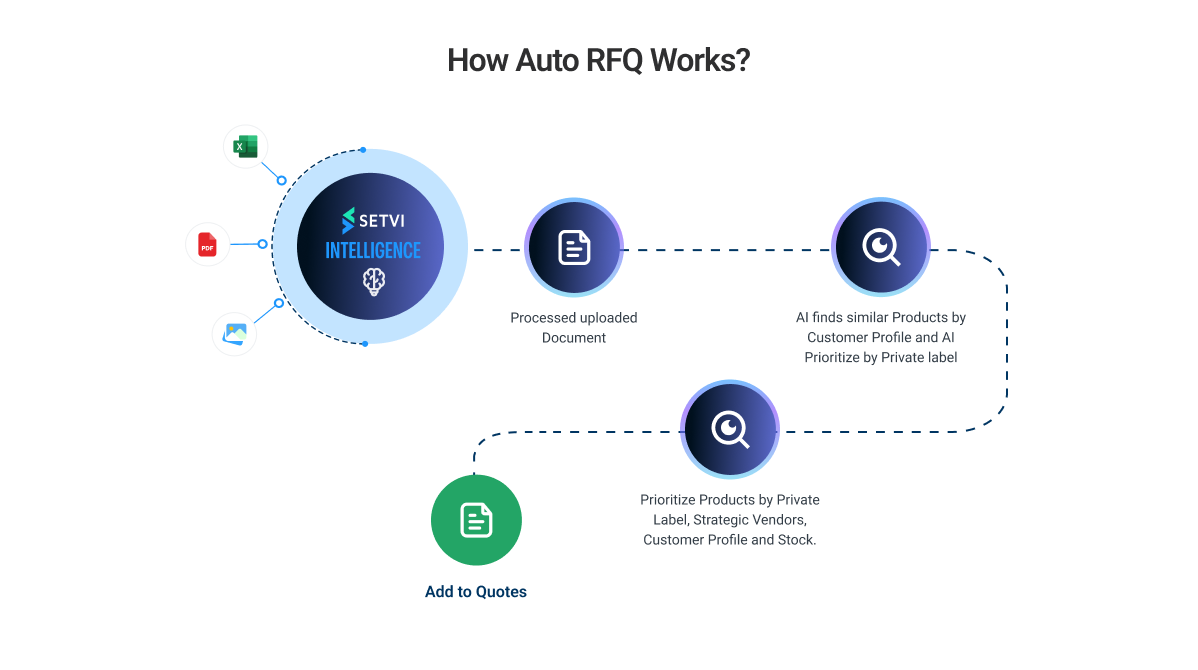
- Auto RFQ extracts item details without manual transcription
- Line items match to active catalog products automatically
- Quote templates populate with correct pricing and formatting
- Reps regain hours previously lost to data entry
Improved confidence in quote accuracy
- Fewer mistakes in part numbers, quantities, or pricing
- Less back-and-forth with customers to correct details
- More predictable customer experience for national accounts
- Reps send quotes knowing the information is reliable
Once again, if we take mundane and repetitive tasks as an example, such as extracting item details, AI supports this by identifying line items, quantities, and descriptions even when RFQs arrive in unstructured formats like PDFs or emails.
In short, these kinds of automated processes achieve revenue enablement, which in turn rebuilds the quoting experience so it becomes smoother, more accurate, and better aligned with customer expectations.
The benefits of revenue enablement for fast, accurate quoting
Revenue enablement creates an immediate shift in how sales teams handle quoting. Faster responses help reps and AMs stay engaged with customers, especially when buyers are comparing multiple suppliers. This improvement often leads to higher win rates, since timing frequently shapes the outcome of an order.
Quoting quality improves as well. When substitutes or related items become easier to include, quotes reach customers with stronger item coverage and fewer gaps. At the same time, teams spend less energy correcting errors or rebuilding templates, giving the entire organization a steadier workflow.
Key outcomes include:
- Faster, more consistent quoting
- Improved accuracy with fewer revisions
- Stronger quotes that open the door to more revenue
Revenue enablement turns quoting into a smoother and more reliable part of the sales process; something customers notice, and teams appreciate.
Putting revenue enablement into practice
Revenue enablement becomes most effective when organizations apply it in small, targeted steps that remove friction from the quoting process. Instead of redesigning everything at once, teams gain better results by improving the areas that slow them down the most.
A practical starting point is creating a clear quoting workflow that every rep and AM can follow. When the sequence is consistent, response times stabilize and managers gain a clearer view of where improvements are needed. From there, automation tools such as Auto RFQ help eliminate repetitive work and shorten the distance between receiving a request and sending a complete quote.
Refining product and pricing access is another key element. When catalog data is accurate, organized, and easy to reference, reps move through quotes with greater confidence and fewer interruptions. This steady foundation makes it easier to scale quoting volume during busy periods or when national accounts require frequent updates.
Core steps for building momentum include:
- Establishing a repeatable quoting process
- Cleaning and centralizing product and pricing data
- Introducing automation for the most time-consuming RFQ tasks
These actions turn revenue enablement into a practical system rather than a broad concept. Once the groundwork is in place, the entire sales organization experiences smoother workflows, shorter turnaround times, and a more reliable quoting rhythm.
How AI-powered Auto RFQ turns revenue enablement into a daily advantage
Revenue enablement gives distributors and manufacturers the structure needed to quote with greater speed and confidence. When quoting becomes easier and more consistent, sales reps, AMs, managers, and owners all benefit from smoother workflows and more predictable customer interactions. Auto RFQ strengthens this shift by removing manual steps and helping teams achieve faster Speed to Quote, a critical factor when customers compare multiple suppliers. The result is a quoting experience that supports long-term relationships and positions the organization to win more often.
Key takeaways
- Revenue enablement replaces fragmented, manual quoting with a consistent process that supports faster responses and stronger customer engagement.
- Auto RFQ eliminates repetitive RFQ tasks, allowing teams to send accurate, complete quotes at a pace that helps them outperform competitors.
- Speed to Quote becomes a measurable advantage when quoting delays disappear, giving teams the timing edge customers rely on when selecting a supplier.
If you want to see how distribution and manufacturing teams eliminate manual RFQ work and respond faster with Auto RFQ, feel free to reach out to our experts.
FAQ
How does revenue enablement differ from traditional sales enablement?
Sales enablement typically focuses on training and content, while revenue enablement addresses the entire process that influences quoting speed and accuracy. It aligns people, workflows, and tools so teams can respond to customers more effectively.
Why is quoting speed so important in distribution and manufacturing?
Customers often request quotes from several suppliers, and faster responses increase the chance of winning the order. Slow quoting also disrupts customer experience and weakens trust with national accounts.
How does Auto RFQ use AI to eliminate manual RFQ processing?
Auto RFQ uses AI to read incoming RFQs, extract line items, and match them to the correct products even when requests arrive in unstructured formats like PDFs or emails. This removes the need for manual transcription and preparation, while sales teams retain full control over pricing and final quote decisions.
What specific quoting tasks does Auto RFQ automate?
Auto RFQ reads RFQs from PDFs, spreadsheets, emails, or images and extracts item details without manual typing. It also matches products to the catalog and formats quotes automatically, allowing reps to focus on customer decisions instead of administrative steps.
Is revenue enablement only useful for large sales teams?
No. Smaller teams often see the fastest gains because they have less bandwidth for manual quoting tasks. Even a modest improvement in speed and accuracy can significantly impact customer retention and monthly revenue.
.png)




.webp)